
Bathroom Moisture Problems: Is the Exhaust Fan Really the Issue?
Bathroom Moisture Problems: Is the Exhaust Fan Really the Issue?
Excess moisture in a bathroom can be frustrating. Steamy mirrors, wet walls, damp cabinets, mildew smells, or moisture around vents can make it seem like the bathroom exhaust fan is not strong enough.
Sometimes the fan is undersized or not working properly. But in many Florida homes, the problem is not just the fan’s CFM rating. Bathroom moisture is affected by shower habits, fan run time, air conditioning settings, closed doors, ducting, dampers, and the amount of humid outside air being pulled into the home.
Before replacing the fan, here are a few simple things to check.
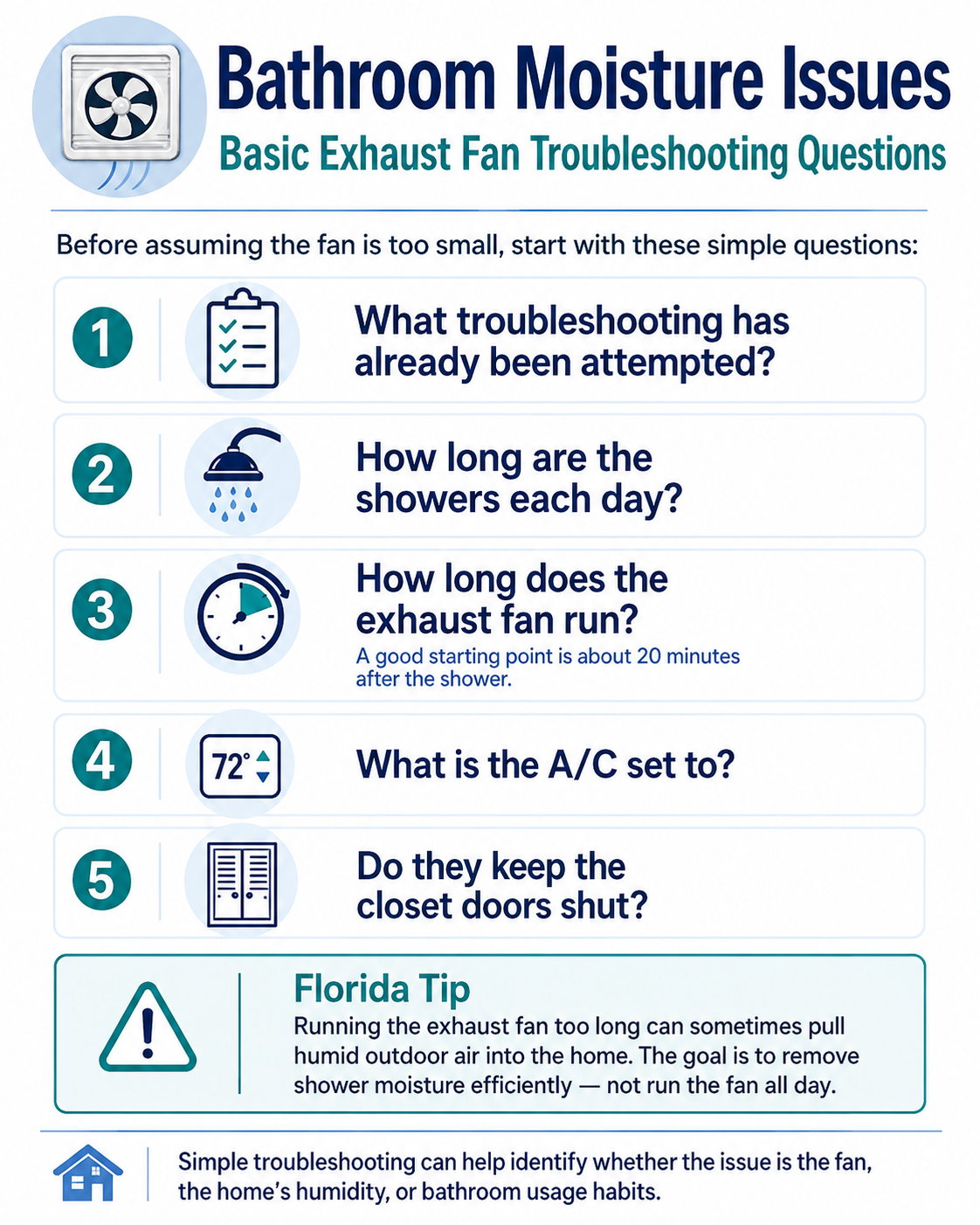
1. Run the Fan During the Shower and After the Shower
The exhaust fan should be turned on before or when the shower starts and should continue running after the shower ends.
A good starting point is:
Run the bath fan during the shower and for about 20 minutes afterward.
Longer showers may need a little more time, but running the fan all day is usually not the answer, especially in Florida.
2. Look at Shower Length
A 5-minute shower and a 30-minute shower do not create the same moisture load.
If the bathroom is staying wet long after the shower, ask:
- How long is the shower running?
- Is the water very hot?
- Are multiple people showering back-to-back?
- Is the bathroom door closed the entire time?
- Are towels, rugs, or shower curtains staying damp?
Long, hot showers create more steam than any fan can remove instantly.
3. Do Not Leave the Fan Running All Day
It seems logical to think, “If the bathroom is humid, leave the fan on longer.”
In Florida, that can sometimes backfire.
Bathroom exhaust fans remove indoor air and push it outside. When air is pushed out, replacement air has to come from somewhere. That replacement air can be pulled through gaps around doors, windows, recessed lights, attic spaces, wall cavities, or other small openings.
This is called negative pressure.
In a humid climate, that replacement air can be hot, damp outdoor air. If that humid air hits cool air-conditioned surfaces, moisture can condense on mirrors, walls, ceilings, vents, or cabinets.
In simple terms: the fan may start trying to dry the bathroom, but if it runs too long, it can begin pulling Florida humidity into the home.
4. Check the A/C Setting
The air conditioner does more than cool the house. It also helps remove humidity.
If the thermostat is set too high, the A/C may not run long enough to dehumidify the home well. If the bathroom already starts out humid, the exhaust fan has a harder job.
Things to consider:
- What temperature is the A/C set to?
- Does the home feel humid in other rooms too?
- Is there condensation around A/C vents?
- Does the bathroom dry better when the A/C is running regularly?
If the whole home feels humid, the bath fan may not be the main problem.
5. Keep Air Moving After the Shower
A bathroom fan needs replacement air to work correctly. If the bathroom door is sealed tightly or stays closed, the fan may struggle to move air.
After showering, it usually helps to:
- Leave the bathroom door open when privacy is no longer needed.
- Leave the shower door or curtain open so the shower can dry.
- Avoid shutting damp towels, rugs, or laundry inside a small closed room.
- Keep nearby closet doors open if those areas are staying damp or musty.
Closed spaces dry slowly. Air movement matters.
6. Check the Fan Itself
Before assuming the fan is too small, make sure it is actually working.
Basic checks include:
- Does the fan turn on?
- Does it sound weak, loud, or different than normal?
- Does the fan grille look dusty or clogged?
- Does the fan pull a tissue up against the grille?
- Is air coming out at the exterior vent when the fan is running?
- Is the exterior flap or damper stuck closed?
- Is the damper stuck open when the fan is off?
A dirty grille, blocked duct, long duct run, crushed duct, stuck damper, or poor exterior termination can reduce airflow even if the fan itself is rated correctly.
7. Check the Exterior Damper
The exterior damper should open when the fan is running and close when the fan is off.
If the damper is stuck closed, the fan cannot exhaust properly.
If the damper is stuck open, outdoor humidity can drift back into the duct or bathroom when the fan is off.
This is a common item to inspect when a bathroom has ongoing moisture complaints.
8. Would a Bigger Fan Fix It?
Maybe — but not always.
A higher-CFM fan can remove bathroom steam faster, which may reduce how long the fan needs to run. However, a larger fan also exhausts more conditioned indoor air. If it runs too long, it can increase negative pressure and pull more humid outside air into the home.
A fan upgrade may help when:
- The bathroom is large.
- There is a garden tub, large shower, or multiple fixtures.
- The existing fan is below recommended sizing.
- The existing fan is old, weak, noisy, or poorly performing.
- The duct and exterior vent are properly sized for the larger fan.
A fan upgrade may not solve the issue if:
- Showers are long and very hot.
- The fan is left running for hours.
- The home has high indoor humidity overall.
- The A/C is not removing enough moisture.
- The duct or damper is blocked.
- Bathroom and closet doors stay closed, trapping moisture.
- Humid outdoor air is being pulled into the home.
9. What About Humidity-Sensing Fans?
Humidity-sensing fans can be useful in some homes, but they are not always ideal in Florida.
Because Florida air is naturally humid, a humidity-sensing fan may run more often than expected. If it runs too long, it may contribute to the same negative-pressure issue by pulling more humid makeup air into the home.
For many homes, a simple timer switch is a better option. A timer allows the fan to run long enough to clear the bathroom after a shower without staying on all day.
Recommended Bathroom Moisture Checklist
Before replacing the fan, start here:
- Run the fan during the shower.
- Let the fan run about 20 minutes after the shower.
- Avoid leaving the fan on all day.
- Shorten very long, hot showers when possible.
- Leave the bathroom door open after showering.
- Leave the shower door or curtain open so surfaces can dry.
- Check whether the A/C is keeping the whole home comfortable and dry.
- Keep closet doors open if moisture is being trapped nearby.
- Clean the fan grille.
- Confirm air is exhausting outside.
- Check that the exterior damper opens and closes properly.
Bottom Line
Bathroom exhaust fans are important, but they are only one part of moisture control.
In Florida, excessive bathroom moisture can come from a combination of long showers, poor air movement, high indoor humidity, A/C settings, closed doors, blocked ducts, stuck dampers, or running the fan too long.
The goal is not to run the fan constantly. The goal is to remove shower moisture efficiently without pulling extra Florida humidity into the home.
A properly working fan, a reasonable run time, good air movement, and a well-performing A/C system usually work together to keep the bathroom dry.